When to run to run fast?
I’ve raced at a lot of BMC events. They’re fantastic. Paced races for a wide range of standards, several opportunities each year, and a supportive environment. Anecdotally, after many of these races, it seems that on the stroll back to the car the conditions have settled - the wind has died and it is slightly cooler. Much calmer than during most of the racing.
The BMC’s stated goal is to ‘improve the world standing of UK Middle Distance Running’. Most often at the BMC, this means running faster times, typically with the goal of qualification times for e.g. British Championship or English Schools. One way I believe we can enable faster times at BMC events is by racing later in the evening. Why? Better conditions. Significantly less windy and, as a bonus, cooler. The rest of this article sets out the evidence for this and makes recommendations to encourage faster races.
High winds have at least two effects on races. First, it’s fundamentally slower. The energy a runner spends battling a headwind is not equally compensated by the equivalent tailwind later in the lap. There is literature on the impact of wind speed in the sprint events such as the 100m. The first plot shows the time delta expected for various wind speeds and it is clear that this is not symmetric. A 6m/s headwind is far more detrimental (~-0.6s) than a 6m/s tailwind is beneficial (~+0.25s). The tailwind does not make up for the headwind. 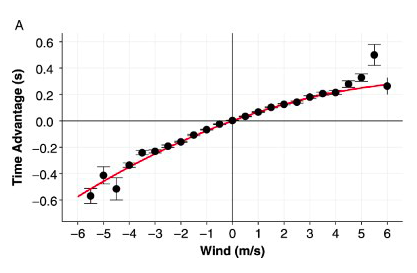
Fighting in the wind is hard, and most people would prefer not to be the person punching the hole in the wind. This leads to the secondary effect where races become tactical affairs as everyone avoids being the rabbit. Who wants to be the one who does all the work such that everyone else is rewarded? With dedicated pacemakers, the BMC does mitigate this, but pacers will drop out around halfway and there is often a reluctance to be the first runner behind the pacer.
While anecdotes are interesting, hard facts are better when it comes to making informed decisions. So let’s take a look at some historic wind speed data. Luckily there is an abundance of data available from weather stations in the UK.
Since races are typically in the afternoon and evening, and in summertime, let’s start by looking at the average wind speed between the times of 3 pm to 11 pm and in the months of May to September. For each month we can plot what the average wind time is at that time of day. This dataset is for a particular station in Coventry and contains data covering the last decade.
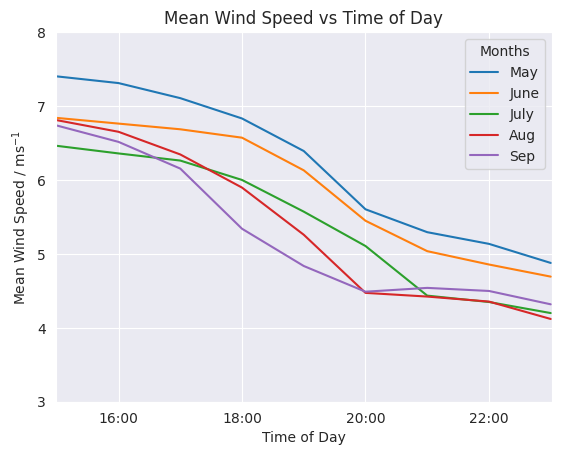
Okay, good, the drop in the average wind speed between 6 pm and 8 pm is significant. Anecdotes line up with the data.
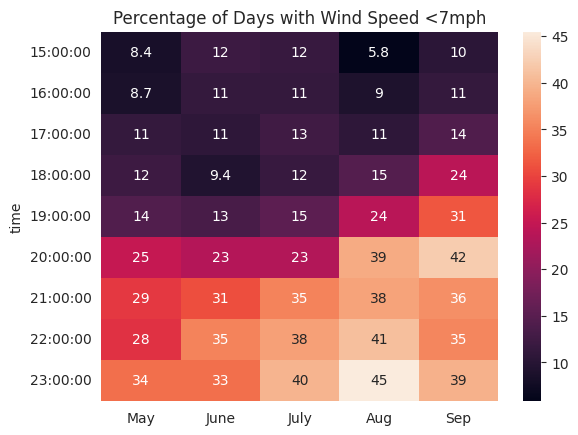
Plotted another way, which is perhaps more useful. The heatmap below shows the probability that the wind speed is below 7mph at a given time of day in each month. Take for example July. Running at 3 pm there is a 12% chance the wind will be below 7mph. By 9 pm the probability of wind <7mph has jumped up to 35% and it continues to improve, reaching 40% at 11 pm.
This chart also shows us a preference for better conditions later in the year. August and September give fine settled weather in the evenings far more frequently than May and June.
A secondary benefit of racing later is the drop in temperature. Particularly for longer races lower temperatures can help performance.
A friend points out that as well as better conditions, there are optimum times of day to run fast based on circadian rhythm.
So, what can we learn from this?
- Prioritize races after 8 pm, ideally after 9 pm, when a fast time is the main goal.
- Plan to race into August and September for the best chance of good conditions.